When customer service supervisors review conversation logs, what worries them most is often not that the machine fails to answer, but that the machine is "too eager to answer"—outputting long-expired promotional policies as current standards, or even promising refunds beyond its authority. As conversational large models penetrate deeper into core business operations, simple keyword matching can no longer handle complex demands. How to establish reliable safety boundaries has become key to evaluating whether a smart customer service system is qualified.
On July 22, OpenAI released the Presence platform, designed to establish strict boundary controls and dynamic review mechanisms for enterprise-level agent deployment. After its internal English phone customer service integrated this mechanism, it not only achieved a 75% self-service resolution rate but also reduced human takeover rates by 15 percentage points through post-hoc closed-loop analysis.
Meanwhile, Bank of America upgraded its assistant system EricaAssist on July 21, providing real-time contextual suggestions within 3 seconds for 18,000 frontline agents, shortening each call by nearly 1 minute on average. Combining these latest practical experiences, enterprises can reconfigure interaction guardrails through the following four key steps to address the common pain point of "overstepping and incorrect answers."
Clarify Decision Granularity: Break Down Permissions and Data Boundaries
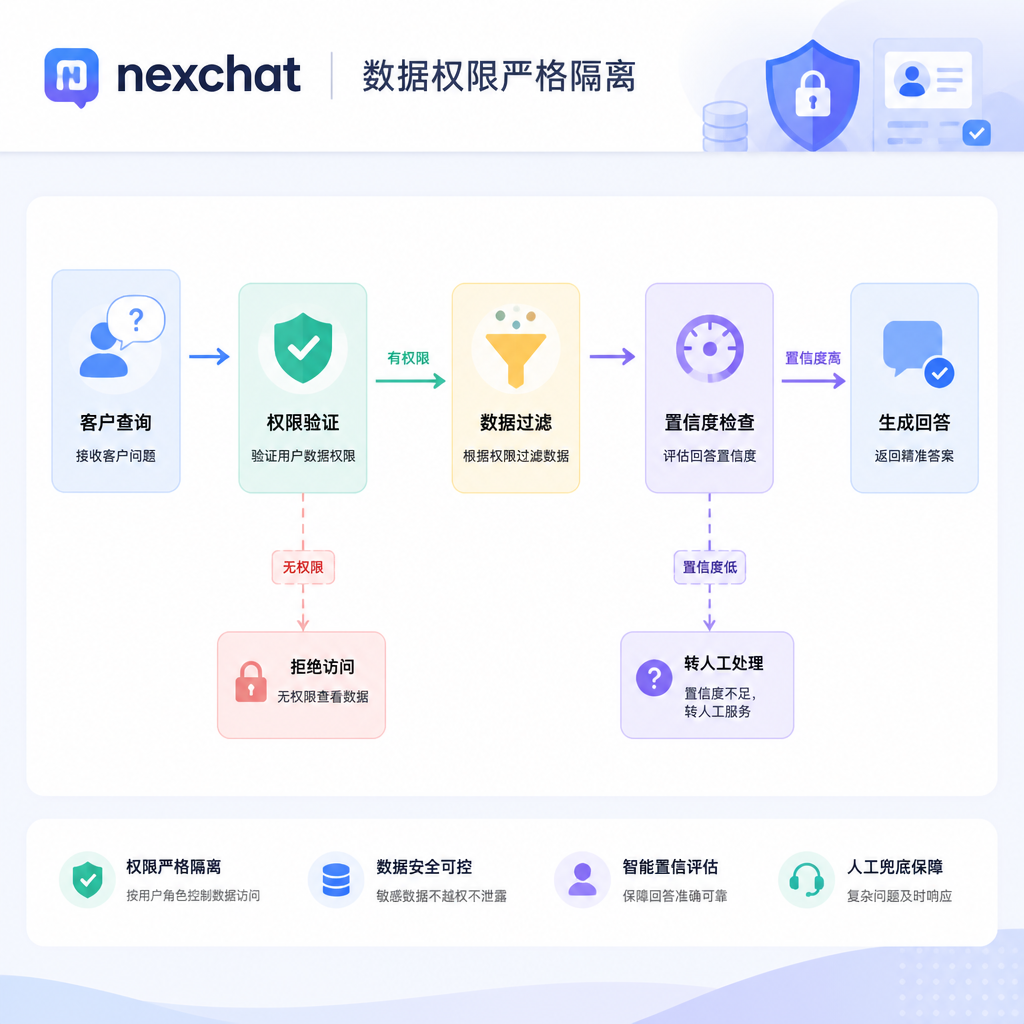
The root cause of many systems giving random answers is injecting too much unnecessary context or high-risk interfaces into the model at once. The first step to preventing overstepping is to minimize data permissions based on roles and tasks.
- Restrict the range of API interfaces called; sensitive operations like refunds and address changes must go through independent authorization.
- Separate public knowledge bases from internal policy documents, shielding drafts or expired documents not intended for customers.
- Set output confidence thresholds, forcing secondary confirmation for ambiguous intents.
For teams integrating nexchat, by presetting business decision chains, replies with extremely high uncertainty can be filtered directly at the engine layer, preventing unverified answers from being presented to the frontend.
Leverage Sandbox and Synthetic Data: Complete Overstepping Stress Tests Before Launch
Directly deploying an insufficiently tested model to production can easily lead to overstepping when encountering uncommon requests. Establishing a pre-launch simulation testing environment is an essential line of defense.
Build a simulated conversation sandbox and use synthetic data to intensively attack the model's boundary rules. For instance, deliberately make unauthorized requests or input contradictory order information to observe whether the system can refuse to answer or transfer to human agents as per preset logic. This adversarial testing can expose gaps in data connections and rule judgments early.
Introduce Codex-style Dynamic Review: Use Unresolved Conversations to Feed the Smart Customer Service System
Pre-launch stress tests cannot cover all real scenarios. The key to continuous optimization lies in establishing a post-hoc review closed loop, turning unresolved conversations into fodder for rule iteration.
Following OpenAI's practice in the Presence platform, the system uses code review tools like Codex to analyze unresolved conversations and transfer records in production environments, automatically identifying deviations in the model's understanding of policies or actions and suggesting modifications. After team review and confirmation, the updated rules are published to production.

Under this mechanism, smart customer service systems can self-correct based on changes in real user behavior without frequently restructuring knowledge bases, continuously improving adaptability to complex business.
Establish Human-Machine Handoff Guardrails: Seamlessly Transfer to Human Agents at Critical Points
Even with perfect defense mechanisms, when faced with extremely complex complaints or special requests, the machine must know when to "cut losses." A seamless human-machine handoff mechanism is the bottom line to prevent error amplification.
In its system update on July 20, Zendesk optimized auto-assisted creation experiences and introduced dynamic suggestions based on resolved historical tickets. Bank of America's EricaAssist practice also confirms this: letting the machine real-time organize background and give suggestions, while humans make the final decision, balances efficiency and safety.
In nexchat's ticket routing settings, when confidence falls below a preset threshold, the system automatically captures context and presents it to the agent. The agent can take over the conversation without requiring the customer to repeat the problem. Returning high-risk decisions to humans is the robust approach to ensure service quality.



Comments(0)